
Amazon is a search engine with a shopping cart attached. Over 60 percent of online product searches start on the platform, and the brands that appear at the top of those results sell more. Amazon PPC is how you get there.
This guide breaks down how Amazon ads work, the campaign types available and the metrics that separate profitable campaigns from expensive ones.
What Is Amazon PPC?
Amazon PPC (pay-per-click) is the platform’s advertising system. You bid on keywords or product targets, your ad appears in search results or on product pages, and you pay only when a shopper clicks.
Three campaign types make up the system.
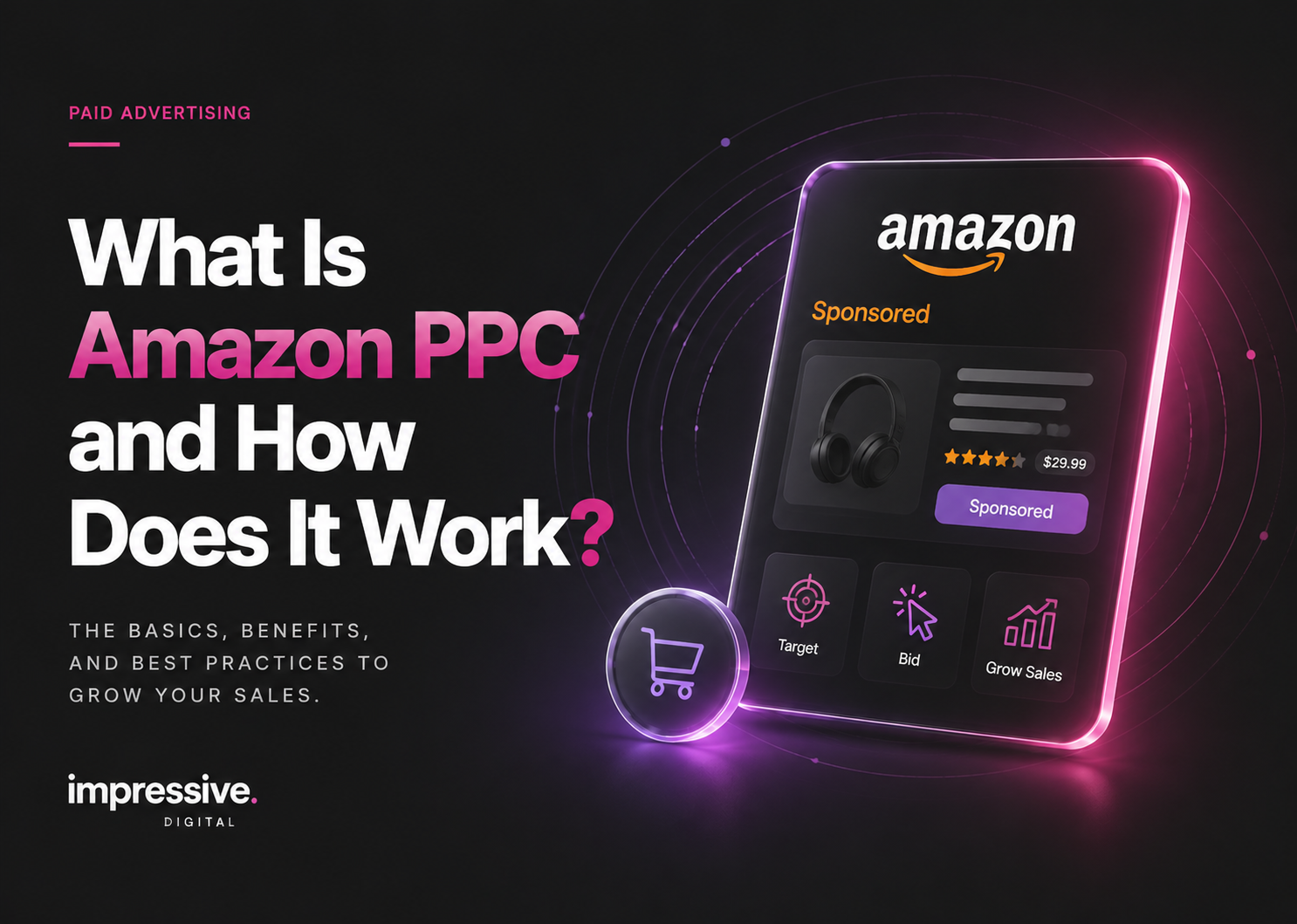
Sponsored Products promote individual listings within search results and on competitor product pages. They look like organic results with a small “Sponsored” label and drive the majority of Amazon ad revenue for most sellers.
Sponsored Brands display your logo, a custom headline and up to three products at the top of search results. They work well for driving traffic to your Amazon storefront and increasing brand recognition among shoppers already searching your category.
Sponsored Display reaches shoppers on and off Amazon based on browsing behaviour, purchase history and product views. The format supports retargeting and competitor conquesting, making it useful for recapturing users who viewed your products but did not purchase.
Understanding how Amazon PPC works starts with these three formats. Each serves a different purpose in your advertising strategy, and most profitable accounts run all three.
How Amazon PPC Works
The mechanics differ from Google Ads and Facebook Ads in a few important ways.
The auction system
Amazon runs a second-price auction. You set a maximum bid for a keyword or target, but you pay one cent more than the second-highest bidder rather than your full bid amount. This keeps costs efficient for advertisers who bid accurately.
The CPC model
You pay per click, not per impression. Your ad can appear thousands of times without cost. You only pay when a shopper clicks through to your listing. That makes strong listings critical because every click costs money, and a poorly converting listing wastes ad spend fast.
Keyword bidding
You choose which search terms trigger your ads. Amazon offers three match types. Exact match targets the precise keyword. Phrase match targets the keyword within a longer search query. Broad match targets related variations and synonyms. Tighter match types give you more control. Broader match types give you more reach.
Targeting options
Beyond keywords, Amazon lets you target specific products, categories and audiences. Product targeting places your ad on a competitor’s listing page. Category targeting reaches shoppers browsing an entire product category. Audience targeting through Sponsored Display reaches users based on shopping behaviour and interests.
How Amazon ads work in practice depends on how well you combine these targeting options. The strongest campaigns layer keyword, product and audience targeting across all three campaign types.
Types of Amazon PPC Campaigns
Sponsored Products
The workhorse of Amazon advertising. These ads appear in search results and on product detail pages. They drive direct sales and generate the data you need to optimise your broader strategy. Most sellers allocate 60 to 70 percent of their Amazon ad budget here.
Sponsored Products support automatic and manual targeting. Automatic campaigns let Amazon decide which search terms trigger your ads based on your listing content. Manual campaigns give you full control over keywords and bids. Running both lets you discover new keywords through auto campaigns and scale winners through manual.
Sponsored Brands
These ads appear at the top of search results as a banner featuring your brand logo, a headline and a selection of products. They drive traffic to your storefront or a custom landing page within Amazon.
Sponsored Brands also support video format, which plays inline within search results. Video ads tend to generate higher click-through rates because they stand out against static listings. Creating this type of content with the help of a video editor works well for demonstrating product features and use cases.
Sponsored Display
The most flexible format. Sponsored Display reaches shoppers based on product views, category browsing and purchase behaviour. Ads appear on product pages, review pages and external sites across Amazon’s display network.
Two primary strategies drive most Sponsored Display performance. Retargeting re-engages users who viewed your product but did not buy. Conquesting places your ad on competitor product pages to capture shoppers comparing options.
Key Amazon PPC Metrics to Track
Running Amazon ads without tracking the right numbers burns budget. These five metrics tell you whether your campaigns are profitable.
ACoS (Advertising Cost of Sale)
Ad spend divided by ad revenue, expressed as a percentage. If you spend $20 and generate $100 in ad sales, your ACoS is 20 percent. Lower is better, but your target ACoS depends on your margin. A product with 40 percent margin can afford a 25 percent ACoS. A product with 15 percent margin cannot.
TACoS (Total Advertising Cost of Sale)
Ad spend divided by total revenue, including organic sales. This metric captures the full picture because strong ad campaigns lift organic rankings, which drives additional sales you are not paying for directly. A rising TACoS often signals over-reliance on ads. A declining TACoS suggests your paid activity is fuelling organic growth.
CTR (Click-Through Rate)
Clicks divided by impressions. A low CTR usually signals weak main images, uncompetitive pricing or poor title relevance. Amazon’s algorithm favours ads with higher CTRs, so improving this metric also lowers your cost per click over time.
ROAS (Return on Ad Spend)
Revenue generated per dollar of ad spend. A ROAS of 5 means you earn $5 for every $1 spent. This is ACoS flipped, and some teams find it more intuitive for comparing performance across channels.
Conversion Rate
The percentage of clicks that result in a purchase. A strong conversion rate means your listing does its job once the shopper arrives. A weak conversion rate means you are paying for clicks that go nowhere. Listing optimisation directly improves this metric.
Common Amazon PPC Mistakes
Targeting too broadly from the start
Broad match keywords and automatic campaigns generate data, but running them without negative keyword management wastes spend on irrelevant searches. Broad targeting works as a discovery tool, not a permanent strategy.
Sending traffic to poor listings
No amount of ad spend fixes a weak listing. If your images are low quality, your title lacks relevant keywords, your bullet points fail to communicate value or your reviews are thin, shoppers click and leave. Fix the listing before scaling the ads.
Ignoring creative in Sponsored Brands
Default headlines and generic product selections underperform. Strong Sponsored Brand ads use specific, benefit-driven headlines and feature products that make sense together. Video ads need to demonstrate the product within the first three seconds or shoppers scroll past.
Skipping negative keywords
Negative keywords prevent your ads from appearing on irrelevant searches. Without them, your campaigns accumulate wasted spend on search terms that will never convert. Reviewing search term reports weekly and adding negatives is one of the highest-impact optimisation habits in Amazon PPC.
How to Improve Amazon PPC Performance
Keyword harvesting
Review your automatic campaign search term reports regularly. Identify search terms that convert and move them into manual campaigns with dedicated bids. This process turns raw data into targeted, profitable keywords.
Bid optimisation
Adjust bids based on performance, not instinct. Increase bids on keywords with strong ACoS and conversion rates. Decrease bids on keywords that generate clicks but no sales. Amazon also offers dynamic bidding strategies that raise or lower bids in real time based on conversion likelihood.
Creative testing
Test main images, A+ content layouts, Sponsored Brand headlines and video creative. Small improvements in CTR and conversion rate compound across your entire campaign portfolio. Rotate creative regularly to avoid ad fatigue.
Listing optimisation
Your listing is the landing page for every ad click. Optimise titles with relevant keywords. Write bullet points that address common purchase objections. Use high-quality lifestyle and infographic images. Maintain a review strategy that keeps your rating competitive. Every improvement to listing quality lifts conversion rates and lowers effective ad costs.
Brands that want specialist support managing these campaigns work with an Amazon ads agency that handles keyword strategy, bid management, creative development and ongoing performance reporting.
What This Means for Your Amazon Strategy
Amazon PPC rewards precision. The sellers who understand how Amazon PPC works, track the right metrics and optimise consistently outperform those who set campaigns and forget them.
Start with Sponsored Products to generate sales data. Layer in Sponsored Brands to increase category visibility. Add Sponsored Display for retargeting and conquesting. Track ACoS, TACoS and conversion rates weekly. Harvest keywords, refine bids and improve listings continuously.
The platform rewards momentum. Products that sell well rank higher organically. Stronger organic rankings reduce long-term ad dependency. Paid and organic performance compound over time, and the brands that invest in structured Amazon advertising strategies build that advantage faster.