
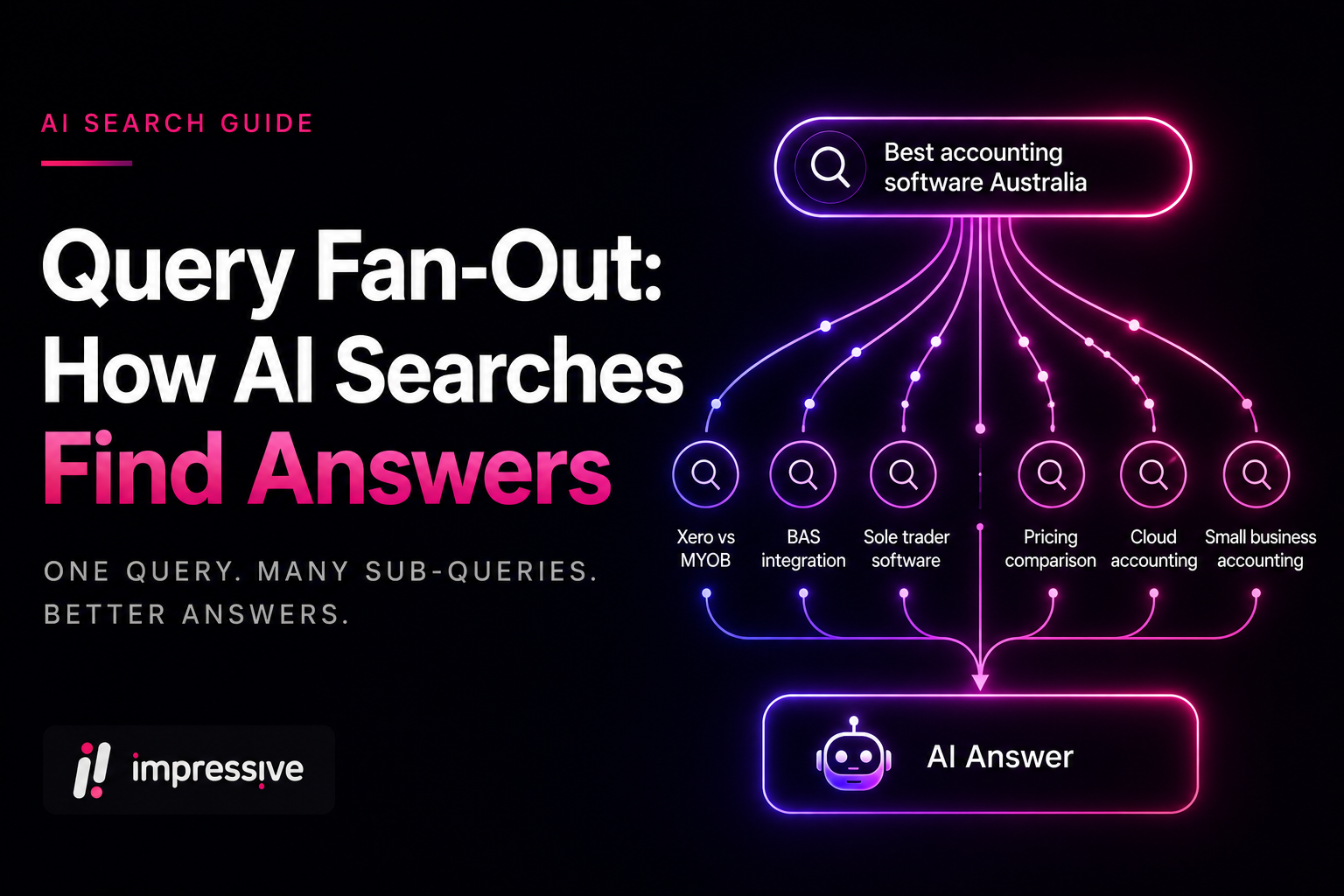
When someone types a complex question into ChatGPT, Google AI Mode or Perplexity, the system does not search for that exact phrase. It breaks the question apart, generates 8 to 16 related sub-queries, runs them simultaneously and combines the results into a single answer.
That process has a name. Query fan out.
Google’s Head of Search Elizabeth Reid introduced the term at Google I/O 2025 when describing how AI Mode works under the hood. The system recognises when a question needs advanced reasoning, breaks it into subtopics and fires multiple queries at the same time on the user’s behalf.
This single mechanism changes how AI search selects sources, how content earns citations and how brands need to think about ai keyword research in 2026. If your SEO strategy still targets one keyword per page, query fan out is the reason it’s losing ground.
What Is Query Fan-Out?
Query fan out is the process AI search systems use to decompose a single user query into multiple parallel sub-queries before generating an answer.
Here is how it works in practice. A user asks “best accounting software for small businesses in Australia.” The AI system does not search for that string. It generates sub-queries like “top accounting software for small businesses 2026,” “cloud accounting tools pricing comparison Australia,” “accounting software features for sole traders,” “Xero vs MYOB vs QuickBooks,” and “accounting software with BAS integration.” Each sub-query retrieves results from different sources. The AI then synthesises everything into one cohesive response.
Your content needs to satisfy the sub-queries, not the original question alone. A page that answers the surface-level query but ignores the surrounding subtopics has less chance of citation than a page that covers the full cluster of related questions the AI generates behind the scenes.
A Surfer SEO study analysing over 173,000 URLs found that 68% of pages cited in AI Overviews did not rank in the top 10 organic results. That finding makes more sense through the lens of query fan out. The AI is not pulling from the top-ranking page for the original query. It is pulling from the best answer to each sub-query. A page ranked seventh that directly answers a specific sub-question can earn citation over a page ranked first that answers the broad topic superficially.
How Query Fan-Out Works in AI Search Engines
Three technical layers drive the process.
Query decomposition
The AI model analyses the user’s input and identifies the distinct subtopics, intent layers and information needs within it. A simple query like “best restaurants in Melbourne” might generate two or three sub-queries. A complex query like “should I switch from Shopify to WooCommerce for a 5,000-SKU store with international shipping” might generate 12 or more.
The more complex the question, the more sub-queries the system fires. This rewards content that addresses specific, detailed questions rather than broad overviews.
Retrieval layers
Each sub-query runs independently against the search index. The system retrieves a separate set of candidate sources for each one. A single AI-generated answer might pull information from six, eight or twelve different pages across different websites. The AI evaluates each source for relevance, accuracy, recency and authority before deciding what to include.
This means your content competes at the sub-query level, not the original query level. You might lose the broad keyword but win three sub-queries and earn citation anyway.
Semantic expansion
The AI understands synonyms, related concepts and implied questions. It expands sub-queries beyond exact-match phrasing to include semantically related terms. A sub-query about “accounting software pricing” might also retrieve results about “monthly subscription costs,” “per-user fees” and “free tier limitations” without those exact words appearing in the original question.
This makes traditional ai keyword research incomplete on its own. Targeting a list of exact-match keywords misses the semantic variations AI systems generate during fan out. The research process needs to map the full cluster of related questions, not a flat list of search terms.
Why Query Fan-Out Changes SEO
Query fan out shifts three fundamentals of how organic search works.
Broader source retrieval
AI systems pull from a wider range of sources than traditional search. A single AI-generated answer might reference content from pages ranked outside the top 10, from niche industry publications, from forums and from newer pages that traditional Google rankings have not yet rewarded. This opens visibility to sources that would otherwise remain invisible in a standard results page.
Businesses investing in structured SEO services now need to optimise for sub-query relevance alongside primary keyword rankings. The two are complementary, but they require different content strategies.
Topical authority becomes essential
AI systems favour sources that demonstrate thorough coverage across a subject. A website that publishes one article on accounting software sends weaker authority signals than a website that covers accounting software features, pricing, comparisons, implementation guides, industry-specific use cases and common mistakes across multiple interconnected pages.
Topical clusters supported by strong internal linking give AI systems more confidence when selecting sources during fan out. The AI evaluates whether your site has depth on the surrounding subtopics, not whether you rank well for the head term alone.
Teams running SEO in Sydney and SEO in Brisbane see this play out in competitive local and national markets. Brands with deep topical coverage earn AI citations more frequently than brands with higher domain authority but thinner content.
Semantic relevance replaces keyword matching
AI sub-queries use natural language, not keyword syntax. The system searches for meaning, not exact phrases. Content written around rigid keyword targets misses the semantic variations that fan out generates. Pages that cover a topic conversationally, answering the question and the questions around the question, align better with how AI systems retrieve information.
How Google, ChatGPT and Perplexity Use Query Fan-Out
All three platforms use fan out, but the implementation differs.
Google AI Mode and AI Overviews
Google uses a custom version of Gemini to power fan out. When AI Mode recognises that a question needs multi-step reasoning, it breaks it into subtopics and issues multiple queries simultaneously against Google’s search index. The system retrieves candidate sources for each sub-query, evaluates them for quality and authority, then synthesises the response. Google’s fan out benefits from 25 years of web indexing, which means the retrieval pool is the largest of any AI search system.
ChatGPT
ChatGPT uses a similar decomposition process during search-enabled conversations. When a user asks a complex question with search activated, the model generates sub-queries, retrieves web results for each one and combines them into a response with inline citations. ChatGPT’s fan out tends to generate fewer sub-queries than Google’s but retrieves from a broader set of source types, including forums, social media and niche publications that Google sometimes underweights.
Perplexity
Perplexity displays fan out more transparently than the other platforms. Users can see the sub-queries the system generates and the sources retrieved for each one. Perplexity’s retrieval layer pulls heavily from recently published content, which means freshness carries more weight here than on Google or ChatGPT. Brands that publish frequently and maintain up-to-date content earn stronger visibility in Perplexity’s fan out process.
The practical implication across all three platforms is the same. Content needs to answer the sub-queries, not the broad question alone. The platforms differ in how they weight recency, authority and source diversity, but the underlying mechanism rewards the same thing. Comprehensive, well-structured, semantically rich content.
How to Optimise Content for Query Fan-Out
Optimising for fan out requires a different approach from traditional keyword targeting. Here is what works.
Map the sub-queries, not the keyword
Traditional ai keyword research gives you a list of search terms with volume data. Fan out optimisation starts by asking what sub-queries an AI system would generate for your target topic. Use AI tools to simulate the decomposition. Enter your target question into ChatGPT, Perplexity and Google AI Mode and study which sub-questions appear in the response, which sources get cited and which subtopics recur across platforms.
Use question-based headings
AI systems match sub-queries to content sections. Headings structured as questions (or close paraphrases of common sub-queries) improve retrieval accuracy. A heading like “How much does accounting software cost for small businesses?” directly matches a sub-query an AI system is likely to generate for a broader accounting software question.
Cover supporting subtopics on the same page or within the same cluster
Fan out rewards topical completeness. If your page answers the primary question but ignores the obvious follow-ups, the AI will pull those answers from a competitor instead. Cover the related subtopics either within the same page (for comprehensive guides) or across a connected cluster of pages with strong internal linking.
Write semantically, not literally
AI sub-queries use natural language variations. A page optimised for the exact phrase “best CRM for real estate” might miss sub-queries phrased as “property management software with contact tracking” or “real estate agent tools for lead management.” Write content that covers the topic conceptually rather than repeating the same keyword phrase.
Add structured data
Schema markup helps AI systems understand the structure of your content and map sections to specific sub-queries. FAQ schema, HowTo schema, article schema and product schema all improve how clearly machines interpret your pages.
Keep content fresh
Perplexity and Google AI Mode both favour recently updated content during fan out retrieval. Pages that have not been refreshed in 12+ months lose ground to newer competitors answering the same sub-queries. Build a refresh cadence into your content calendar.
What Query Fan-Out Means for GEO
Query fan out is the mechanism that makes Generative Engine Optimisation necessary. When AI systems decompose queries and pull from multiple sources, the brands that earn citations are the ones with content covering the full ecosystem of related subtopics.
Single-keyword strategies no longer cut it. A brand that ranks well for one head term but has no supporting content around the related sub-queries will lose citations to competitors with deeper topical coverage. The AI does not care about your ranking for the primary keyword. It cares about whether your content answers the specific sub-question it generated.
This is why AI SEO programmes now focus on topical ecosystems rather than keyword lists. The goal is to ensure your brand has a strong, well-structured answer for each sub-query the AI is likely to generate around your core topics. That requires comprehensive content planning, strong internal linking, semantic writing and ongoing measurement of which sub-queries your content wins and which ones competitors take.
Brands that understand query fan out and optimise for it will earn more AI citations, appear in more AI-generated answers and maintain visibility as AI search continues to absorb a larger share of the discovery journey. The brands that keep targeting individual keywords will keep wondering why their rankings look fine but their AI visibility does not move.
What This Means for Your 2026 Strategy
Query fan out has changed the rules of AI search visibility. One query becomes many. One answer pulls from many sources. The brands that show up in those answers are the ones with content that satisfies the sub-queries, not the ones that rank highest for the original term.
Rethink how your team approaches ai keyword research. Map the sub-queries. Cover the surrounding topics. Write for meaning. Structure for machines. Keep content fresh. The compounding starts when your content consistently wins across the cluster of questions AI systems generate behind every search.