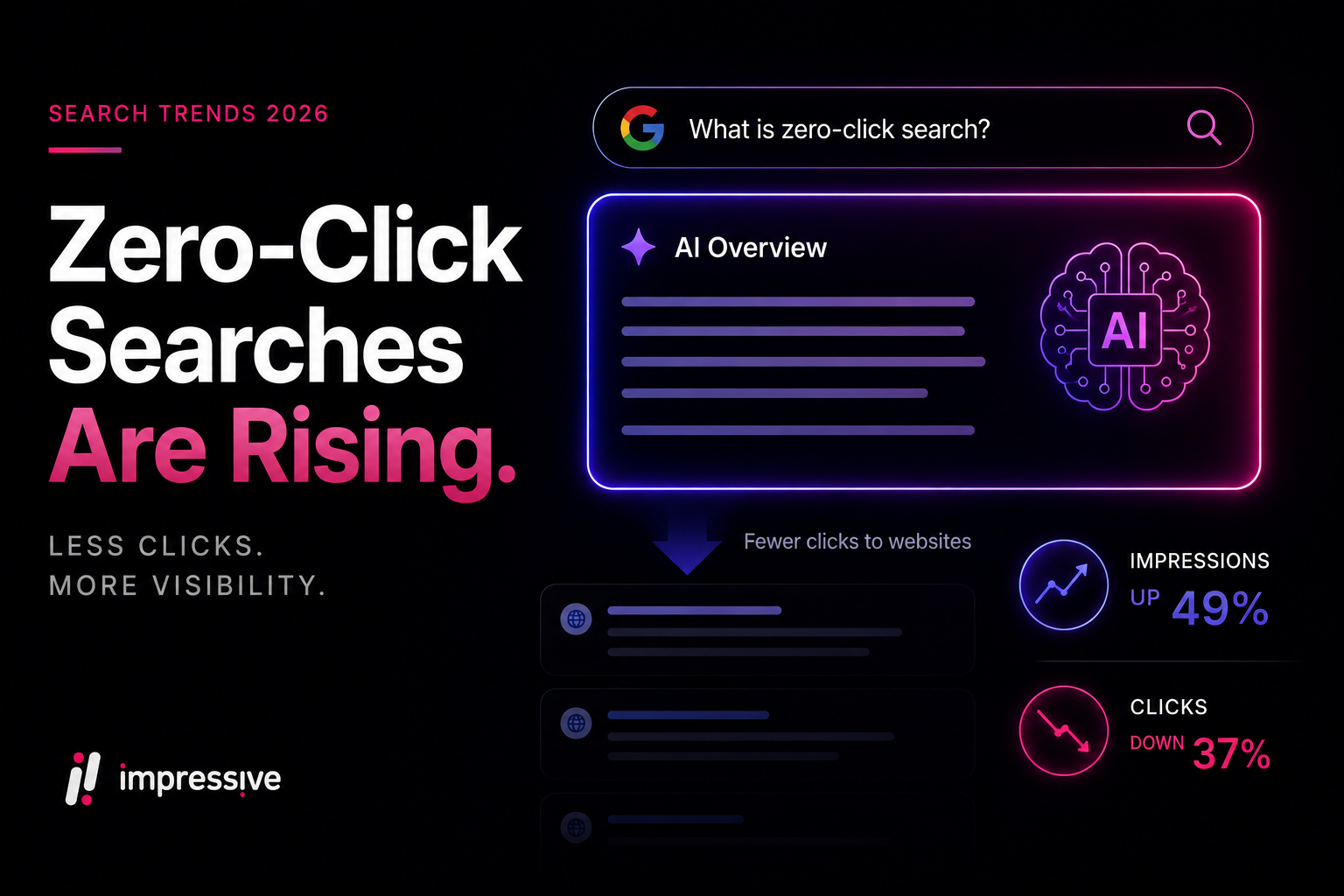

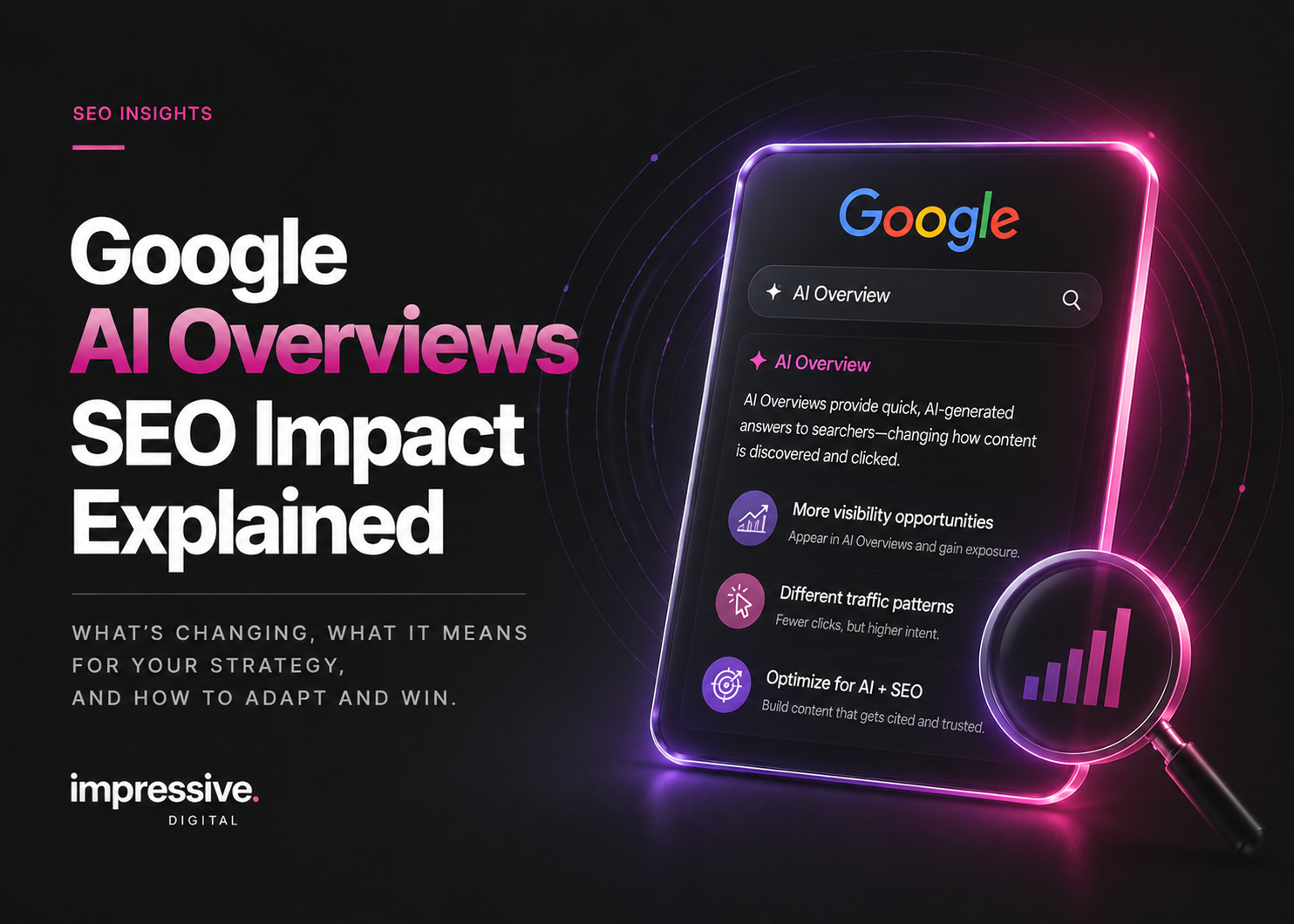
Google now answers a growing share of queries before users reach a website. AI Overviews generate a summary at the top of search results, pulling information from multiple sources and presenting it as a single, cohesive response.
That changes how users interact with search results. It also changes what AI overviews means for SEO teams measuring performance, producing content and competing for visibility. This guide breaks down the impact and covers what to prioritise in 2026.
What Are Google AI Overviews?
AI Overviews are AI-generated summaries that appear at the top of Google search results for eligible queries. Google’s systems analyse multiple sources, extract relevant information and compile a response that addresses the user’s question directly on the results page.
The feature now appears in over 25 percent of Google searches and reaches 1.5 billion monthly users across more than 120 countries. AI Overviews trigger most frequently for informational and research-oriented queries, though Google continues expanding coverage into commercial and comparison searches.
Each AI Overview includes inline citations linking to the sources that informed the response. Users can click through to those sources, though the majority do not. The format gives Google’s AI the role of summariser, with individual websites supplying the raw material.
How AI Overviews Change Search Behaviour
AI Overviews reshape the relationship between query and click. Three behavioural shifts carry the most weight.
Fewer clicks per query
Research shows that queries triggering AI Overviews produce zero-click rates of roughly 83 percent, compared to around 60 percent for traditional results. Click-through rates to the top organic result drop by an estimated 58 percent when an AI Overview appears. Users read the summary, get what they need and move on.
Answer-first search
Users increasingly expect the answer on the results page rather than on a website. AI Overviews train that expectation. Over time, users spend less time evaluating blue links and more time reading the generated response. The search results page has become the destination for a growing share of informational queries.
Conversational search patterns
AI Overviews encourage longer, more conversational queries. Users ask multi-part questions because AI Overviews handle complexity better than traditional keyword matching. That shifts the query landscape away from short, transactional keywords and toward natural language questions that carry richer intent signals.
These behavioural changes affect every business relying on organic search traffic. Understanding what AI overviews means for SEO starts with accepting that the click is no longer the default outcome of a query.
How AI Overviews Impact Organic Traffic
The traffic impact varies by industry and content type, but the patterns are consistent.
Pages targeting pure informational queries see the sharpest declines. “What is” queries, definition pages and basic explainers lose traffic because AI Overviews answer these questions without requiring a click. Businesses that depend on top-of-funnel informational content for traffic need to rethink how that content delivers value.
Search Console data for many sites shows rising impressions alongside flat or declining clicks. Content appears in more searches because AI Overviews reference it, but users interact with the summary rather than clicking through. The gap between impressions and clicks continues to widen.
Users who see your brand in an AI Overview may search your name days later, visit directly or convert through a paid channel. Traditional last-click attribution misses the role AI Overviews played in putting your brand into the consideration set. Teams running SEO services now need to track branded search lift, direct traffic changes and assisted conversions alongside organic click data.
What Types of Content Perform Well in AI Overviews
AI Overviews favour content that AI systems can extract, verify and present clearly. Four formats earn citations more consistently than others.
FAQ-structured content
Direct question-and-answer formatting aligns with how AI Overviews construct responses. Content that opens with a clear answer in the first sentence of a section earns higher inclusion rates than content that buries the answer in supporting paragraphs.
Comparison content
AI Overviews frequently trigger on “vs” and “best” queries. Content that organises comparisons into structured formats with clear differentiators gives AI systems the raw material to generate useful summaries. Tables, feature breakdowns and side-by-side assessments perform well.
List-based content
Structured lists with clear headings and concise explanations under each item give AI systems easy extraction points. Step-by-step guides, ranked recommendations and categorised lists all earn consistent AI Overview citations.
Expert-led content
Content that includes original data, practitioner insights, named author expertise and first-hand experience earns citation over generic informational pages. Google’s systems increasingly distinguish between content that adds new information and content that repackages existing material. Author credentials, publication history and subject-matter authority all influence how AI systems evaluate trust.
How to Optimise for AI Overview Citations
Earning a citation inside an AI Overview requires a different optimisation approach than ranking on page one. Five areas carry the most weight.
Schema and structured data
Schema markup helps AI systems interpret what your content is about, who wrote it, when it was published and what entities it covers. FAQ schema, article schema, author markup and organisation schema all improve how clearly machines read your pages. Strong technical SEO foundations make content easier for AI systems to retrieve and reference.
Entity SEO
AI systems interpret entities and relationships, not keywords. Your brand, products, people and locations need consistent structured data that machines can verify across sources. Knowledge Panel presence, clean entity relationships and accurate associations between your brand and its core topics all improve citation likelihood.
Topical depth
AI systems favour sources that demonstrate thorough coverage across a subject. A single article on a topic sends weaker authority signals than consistent, interconnected coverage across related subtopics. Topical clusters supported by strong internal linking give AI systems more confidence when selecting sources. Teams running AI SEO programmes structure content around topic clusters rather than individual keyword targets.
First-hand expertise
Google’s May 2026 updates surface perspectives from forums, discussions and social media inside AI responses. Content that includes original research, case studies, practitioner commentary and specific examples earns citation over generic explainers. AI systems increasingly reward content that adds something new to the conversation.
External authority signals
Citations from trusted publications, news outlets and industry sources strengthen how AI systems evaluate credibility. Digital PR now contributes directly to AI visibility because mentions across reputable sources reinforce the trust signals that AI systems assess when selecting which content to cite.
Is SEO Still Worth It in 2026?
Yes. The mechanics have shifted, but the principle holds. Businesses that produce clear, authoritative, well-structured content earn visibility where their audience researches and makes decisions.
What has changed is where that visibility lives. Rankings still matter for queries that AI Overviews do not cover, and they remain a factor in which sources AI systems select. Organic content still drives brand awareness, consideration and conversions. The channel has not disappeared. The measurement framework needs updating.
SEO now operates across two layers. Traditional rankings capture clicks from queries where AI features do not appear. AI visibility captures presence inside generated responses where clicks are less frequent but brand influence runs deeper. The strongest strategies address both.
Businesses running SEO in Sydney, Adelaide, Perth and Brisbane see this play out in local and national search results. AI Overviews absorb a growing share of informational queries, but commercial, transactional and local queries still generate clicks. The brands that invest in structured content, entity clarity and authority signals maintain strong positioning across both environments.
SEO is worth it. The teams that adapt how they measure success, produce content and develop authority will hold stronger positions than those treating 2026 like 2022.